15 November 2026
Every climber remembers summit night. It is long, cold and tough, and for most people it ends with one of the best sunrises of their life.
Before midnight
You arrive at high camp (usually Barafu or Kibo) in the afternoon. You eat an early dinner, prepare your clothes and try to sleep for a few hours. Lay everything out so you can dress quickly in the dark.
Around 23:00–00:00
Wake-up call, tea and biscuits. You put on all your layers, headlamp on, and the group starts walking slowly in a line of lights.
00:00–05:00: the long climb
This is the hardest part: steep switchbacks over scree and rock, in the dark and the cold. Temperatures can be well below freezing, with wind. Guides set a very slow pace and stop briefly to let you drink and eat something. Keep your water bottle inside your jacket so it does not freeze.
Around 05:00–06:30: the crater rim
You reach Stella Point (from Barafu) or Gilman's Point (from Kibo). The sky starts to colour behind Mawenzi. For many people this is the emotional moment.
Uhuru Peak
From the rim it is another 45 to 90 minutes along the edge to Uhuru Peak, 5,895 m. Glaciers on one side, the plains of Africa below. You take your photos, and then you go down fairly quickly, because staying long at this altitude is not wise.
The descent
You descend to high camp for a short rest and a meal, and then continue lower to sleep. In total summit day can be 12 to 16 hours of walking.
Tips
- Warm gloves, with liners underneath.
- Snacks you like, even if you are not hungry.
- Batteries for your headlamp kept warm.
- Listen to your guide.
Read our packing list or plan your climb.
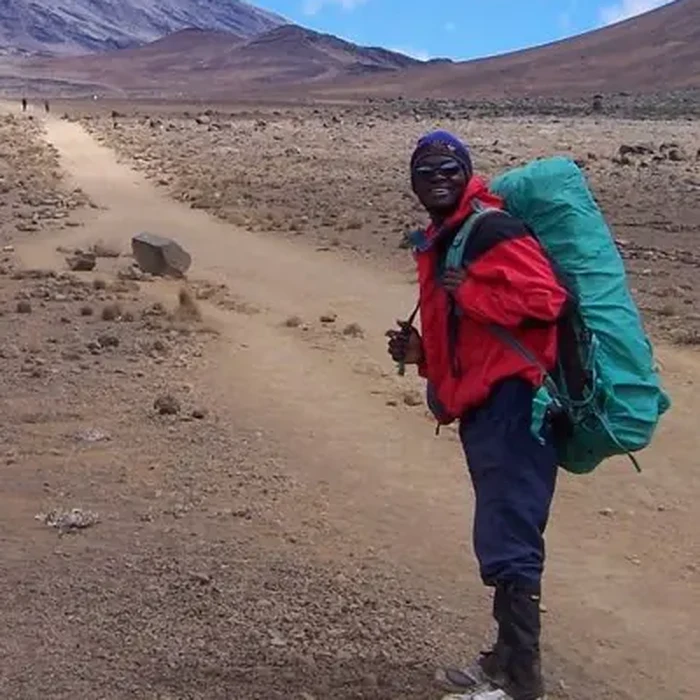
Cover photo: Samson Tarimo on Unsplash (Unsplash License). Illustrative photo; see our photo credits.