
22 December 2023
The people who live in this East African gem are every bit as varied as its landscape – think mountains, savannahs, jungles, crater, lakes and crater lakes. More than 100 ethnic groups make the country their home, and naturally each has a language of its own. Counting over 120 languages and dialects, Tanzania has more than any other country in Africa, which gives it a cultural depth without equal.
Even before reading this, you may have asked yourself whether your English will be enough on a trip to Tanzania, haven’t you? Spoiler: it will! Still, let’s look at the main languages spoken in Tanzania, and we will even give you a few basic Swahili skills. The more you know…
How many languages does Tanzania have?
Altogether, 126 languages are spoken in Tanzania, two of which – Swahili and English – are official. Besides these, there are roughly 18 developing, 58 vigorous, 40 endangered and 8 dying languages.
Which language is spoken most in Tanzania?
That is Swahili, spoken by about 90% of the people of Tanzania. Tanzanians also call it Kiswahili, and it is the main language of social life, politics and education.
English is the second institutional language. Even so, it has served as a second or third language and is taught in schools. The standard is not very high, however, so people may be able to read English yet find it harder to understand when spoken.
The history of Swahili in Tanzania
The common view is that the language grew out of trade between the Arabs and the coastal peoples of East Africa, with a core rooted in Bantu languages. From around the 19th century, many Kenyans and Tanzanians began to identify as Swahili. Once the country was independent, Swahili was made Tanzania’s national language to bring the new nation together.
Swahili is now the main language in Tanzania, and the government continues to push for it to be the sole official Tanzanian language. Recently Swahili also became the main language throughout the education system. With this decision, Tanzania became the first sub-Saharan country to make a native African language the only official language of education.
The history of English in Tanzania
During the British colonial period, from 1919 to 1961, English was Tanzania’s dominant language. Once Tanganyika and Zanzibar had become the independent United Republic of Tanzania, though, Swahili took its place.
English long stayed the main language of secondary and higher education. As mentioned above, that has changed, and Swahili is now used throughout the education system.
Even so, English is still fairly popular, and on your travels in Tanzania you will certainly meet plenty of people who speak it, above all in the larger cities and tourist areas.
Other languages widely spoken in Tanzania
With this overview of the official languages of Tanzania behind us, let’s turn to a few less well-known but still widely spoken languages in Tanzania.
These are ethnic languages spoken by more scattered communities and peoples. They may be less widely spoken, and the Tanzanian government may not recognise them as official languages, yet they matter to the cultural landscape just as much as any other.
Which other native Tanzania languages might you come across, then, as you travel through this marvellous country?
- Kisankasa shows well how rich and varied the country’s linguistics are: it is a Bantu language that is still widely used. Roughly half of the Kisi people, who come from the Njombe region, speak it.
- Pare, also called Chasu, Athu and Chathu, is another Bantu language group, spoken by the Pare people in north-east Tanzania. Around 500,000 people use Pare to communicate, so it is used more than other dialects and some indigenous languages.
- Bemba is spoken in southern Tanzania, as well as in the Democratic Republic of the Congo and Zambia. Most of the country’s indigenous people use it as a common or bridge language, and it goes by names such as Chibemba, Cibemba and Ichibemba, to mention just a few variations.
- Hehe, native to the Iringa region, which lies south of the great Ruaha River, has a complex tense-aspect-mood system. Fewer than 200,000 people speak the language, and over roughly the last 150 years it has lost some of its distinctive features.
Maasai, Digo, Datooga and Chindali are among the other popular indigenous languages. We know Tanzania inside out (the name Your Tanzania Trip did not appear out of thin air), and still we keep discovering the dialects and indigenous sub-languages of different tribes. Exploring simply never gets dull 😉
Tanzania languages that have lost usage
Languages fading slowly and finally dying out is a natural process, all the more so in countries with a varied linguistic landscape such as Tanzania.
In Tanzania, one such language is Asa, from the Asa people of the country’s northern region. Nobody speaks it natively any more, though. Certain word forms may still mean something to particular communities, while others are a fading memory of an older generation.
Honestly, keeping track of all of the roughly 126 native languages in Tanzania is not easy. Some may be simple to identify, but political decisions have a large influence on which languages are promoted and integrated within communities.
Many people, for example, hold the Tanzanian government responsible for the continuing extinction of indigenous languages. Policies such as promoting Swahili on a wide scale and banning ethnic languages and dialects from television or schools make it very hard to preserve these sub-languages.
For the time being, however, the variety of Tanzania’s linguistic landscape is still there for us to enjoy and explore. How long that will last, we cannot say…
Other languages in Tanzania that deserve a mention
We also don’t want to overlook the ‘imported’ languages, such as French, German, Portuguese, Gujarati, Arabic and Hindustani.
French, for example, is one more language widely spoken in Tanzania. It has lately even been added to the school curriculum, and around 1.5 million people in Tanzania are thought to speak it well.
In the tourism industry, nearly every tour operator works with English-speaking guides, and sometimes with guides who speak Spanish, French, Italian, German and Japanese too.
Still, if you are after an authentic Tanzanian experience and want to communicate in quieter areas, picking up some Swahili is a good idea.

Some Swahili words to help you out
A few basic Swahili words help you bridge cultures and make your Tanzania experience a lot easier – and you will put a smile on many faces, your own included. So take a pen and your vocabulary book, and write down a few of these essentials.
Greetings
- Hello – Habari or Mambo (closer to “What’s up” or “How are things”), and with people older than you, use Shikamoo, to which the reply is Marhaba
- Goodbye – Kwaheri, or kwa herini when speaking to more than one person
- How are you? – Habari gani
- Pleased to meet you – Nafurahi kukuona or Ninafuraha kukutana na wewe
- See you later – Baadaye and Kwa heri when you will be apart for longer, or Kesho in the evening when you will not meet again until the following day
Use In Conversation
- Yes – Ndiyo
- No – Hapana
- Everything is fine, or I am well – Poa in reply to Mambo, Nzuri in reply to Habari, or Marhaba when the person answering is older
- Thank you – Asante
- Please – Tafadhali, or Naomba to ask for something politely
- Excuse me – Samahani, or Pole, which also means sorry and expresses empathy
- Could you help me? – Tafadhali or naomba msaada
- What is (insert word) in Swahili? – Unasemaje (insert word) Kwa Kiswahili
Navigation
- Where can I find the (insert place)? – (insert place) iko wapi?
- Bus station – Stesheni ya basi or Kituo cha mabasi
- Bus stop – Stendi (ya basi)
- Train Station – Kituo cha treni
- Bank – Benki
- Market – Soko
- Police station – Kituo cha polisi
Health and Emergency
- I need a doctor – Nahitaji daktari
- I’m sick/ill – Mimi ni mgonjwa
- Where is there a (insert service)? – (insert service) iko wapi?
- Doctor – Daktari
- Hospital – Hospitali
- Medical center – Kituo cha matibabu
- I have pain here – Inauma hapa or naumwa hapa
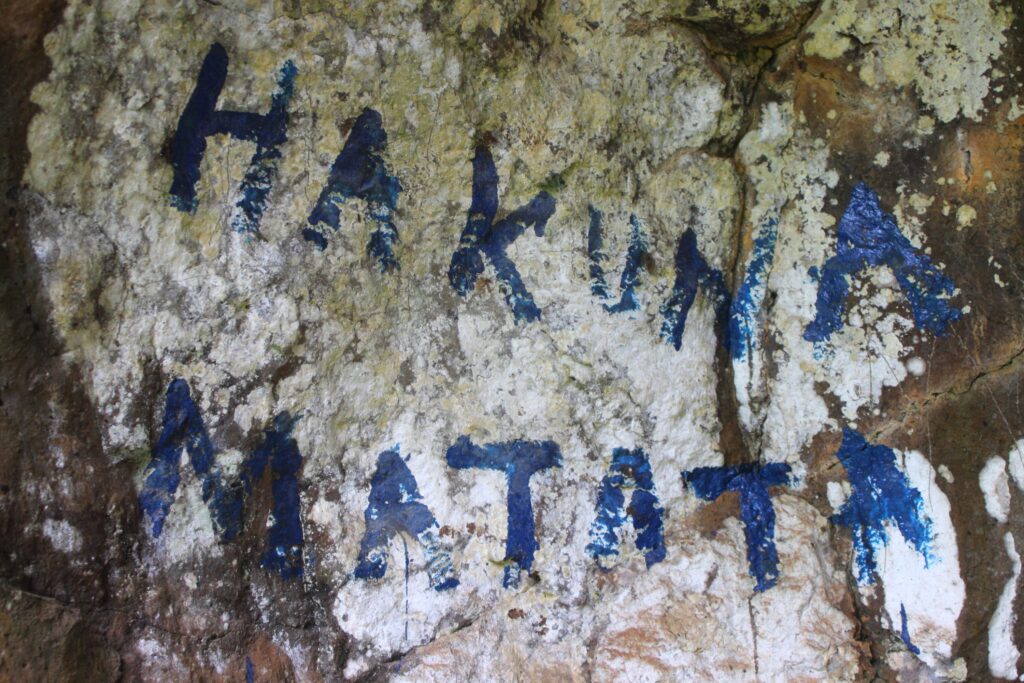
Some tips for a smooth trip
You certainly don’t have to become fluent in Swahili, Tanzania’s national language, before your holiday. As mentioned, English will get you around this country without trouble. If you would like to prepare a bit so you don’t end up in a linguistic pickle, though, here are three tips:
- Write the key Swahili phrases down in a little black book (or a red one, or brown…) or store them on your phone
- Get yourself an English-Swahili app
- And if all else fails, just ask your guide and smile 🙂
If you would like to prepare a bit further, have a look at our detailed guide to planning a trip to Tanzania, watch some documentaries or pick up books about Tanzania and by Tanzanians. That way you will know more about local customs and traditions, which makes your experience all the more authentic. A few typical customs here? Greet people, use your right hand to eat, ask before you photograph anyone, and respect the views and beliefs of older people.
You will find more guides and information about Tanzania on our blog. Got specific questions about travelling to Tanzania? Feel free to get in touch with us directly. We would be glad to help you plan your next big adventure!